
Deed Types in Hinds County Land Records
A deed records a claimed transfer of land. Its parties, legal description, execution details, and recording reference link one owner of record to the next. Hinds County deed records hold more than sale deeds. Deeds of trust, liens, releases, powers of attorney, and plats sit beside them in the same system, so the document's label matters when you run a property search.
| Deed Type | What It Does | Common Use |
|---|---|---|
| Warranty deed | Conveys the stated interest with warranties | Ordinary sale |
| Quitclaim deed | Conveys whatever interest the grantor holds | Family or corrective transfer |
| Trustee's deed | Conveys through a trustee's authority | Trust or foreclosure setting |
| Executor's deed | Conveys through estate authority | Probate transfer |
| Tax deed | Documents a tax-sale-related conveyance | Delinquent-tax trail |
A deed of trust secures debt, not land. That difference matters. Liens work differently still, asserting a recorded claim against the property, so search every relevant series because an ownership chain and its encumbrances never live in a single document.
Search Fields in the Hinds General Index
The Hinds General Index offers few fields, and that narrowness works in your favor. Its choices mirror how Hinds County deed records are organized. Start with a complete party name. From there, select the role and pick the record series. Narrow the dates from there as well. Run the name under both roles when the instrument type or transfer direction is unclear.
| Index control | Choices | Use |
|---|---|---|
| Name | Last, first | Find an indexed party |
| Party role | Grantor, grantee, both | Separate giving and receiving |
| Series | Deed of Trust, Deed Book, both | Distinguish transfer and security trails |
| Date | From and through | Narrow a large result set |
The image below comes from the official Hinds County General Index.
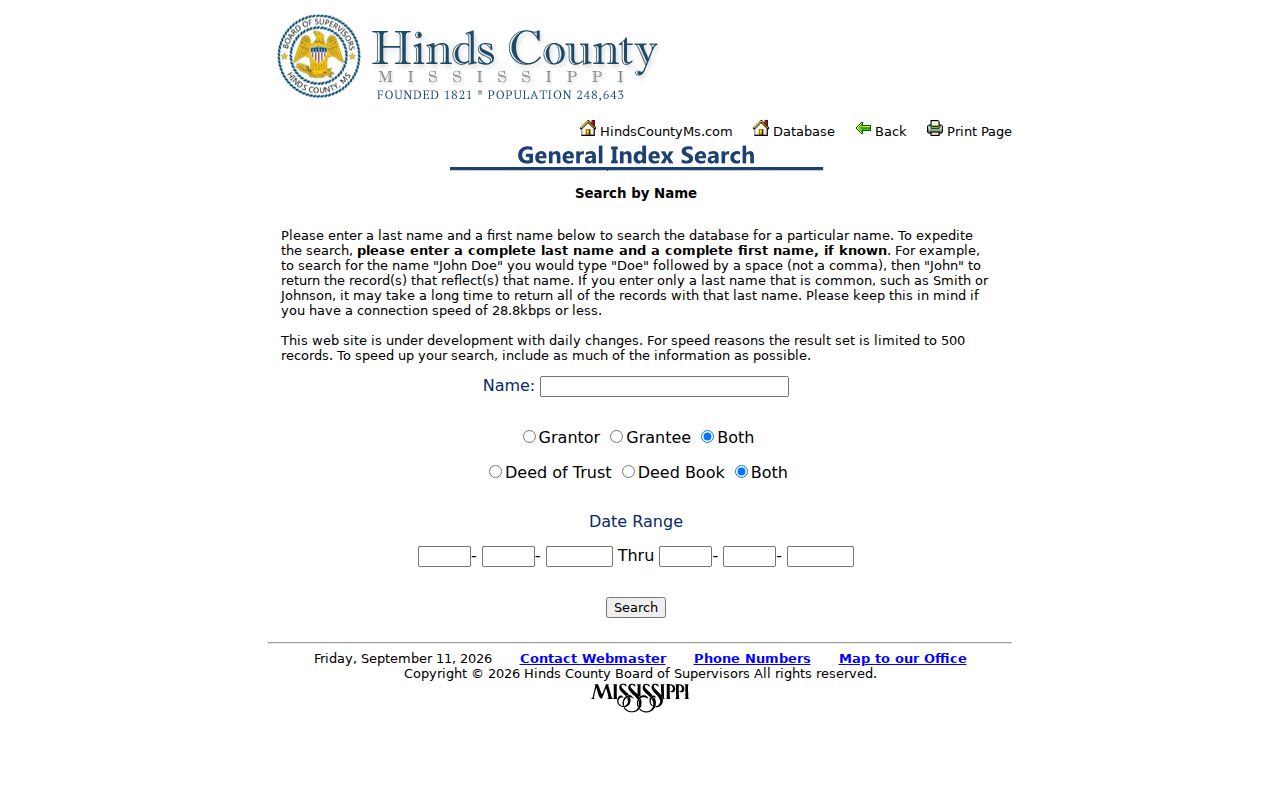
Role, series, and date controls make a search precise. The index states no earliest year, though, so older chains may need an offline fallback at the clerk's counter.
Hinds County Deed Records Use Two Districts
Hinds County runs on two seats. Raymond became the county seat in 1829, and Jackson joined as the First Judicial District seat after the 1870 split. Modern land-record access still follows that divide, with the Jackson First District and Raymond Second District offices each holding their own deed books. A mailing line alone will not settle it. Call the office before you travel. The Jackson land-record number is 601-968-6515, while Raymond uses 601-857-8055. Give the clerk party names, an approximate recording date, the instrument type, a parcel or legal description, and any book and page reference, so staff can identify the record without performing a prohibited title search. That preparation saves everyone time.
Original-only filings can be mailed to either district. Even so, the office directs filers to call land records first. For retrieval, trust the district named on an older index, map sheet, tax-sale file, or court matter. The web database hub can look unified. A physical volume still sits at one counter. Confirm custody before traveling or sending payment, especially when the parcel lies near Clinton, Raymond, or a city boundary.
Deed Book and Deed of Trust Are Separate Choices
The General Index demands a record-series choice. A deed conveys the stated land interest. A deed of trust generally secures debt against the property instead. Searching only Deed Book misses the security trail. Searching only Deed of Trust leaves the conveyance chain unproven. Run both series whenever the goal is broad recorded due diligence. That is the safer habit for Hinds County property records.
Other Chancery instruments add context. These include releases, construction liens, lis pendens, land-record UCC filings, federal tax liens, powers of attorney, subdivision indexes, and plats. None states present legal effect alone. Read the instrument itself and check for later releases or corrective filings.
When Online Hinds County Deed Coverage Ends
The official General Index states no earliest online year. Treat that gap as real. Do not swap in a guessed cutoff. When an online name search stops producing a reliable chain, ask the clerk about deed books, sectional indexes, subdivision indexes, condominium indexes, microfilm, and originals.
The Mississippi Department of Archives and History gives the older path substance. Its Hinds holdings include right-of-preference documents from 1822 and 1823, an 1826 deed of trust, an 1833 public sale, 1838 indentures, and 1841 to 1842 transactions. Digital year groups run through identified 1888 land material. Catalog dates describe archive holdings, not the web index.
Build the backward chain one transfer at a time. Start with a current grantee. Read the acquisition deed for its grantor and legal description. Then search that grantor as an earlier grantee. If the name path breaks, try the sectional or subdivision index along with probate or estate material. A historic catalog entry helps only after its land and parties match later recorded descriptions.
A Byram Deed Trail Shows Book-and-Page Work
The Lewis House story offers a concrete clue. Research on that property near Old Byram Road cites Deed Book 27, page 255, for an 1859 transaction and Deed Book 29, page 723, for an 1866 one. Those citations show the point. A book and page can carry a property story far beyond a modern address search in Hinds County deed records.
Treat historic examples as starting points, not proof about a present parcel. Match names first. Then match legal descriptions, adjoining owners, plats, and later conveyances before tying an old instrument to current land. Byram's charter language also names Hinds plat books for modern subdivisions.
Recording and Copy Charges in Hinds County
The Hinds fee sheet works like an archive-fee schedule. Most instruments fall under one line. Deeds of every type, leases, plats, covenants, construction liens, lis pendens, powers of attorney, and land-record UCCs are covered. Miscellaneous documents cost $26 for the first five pages. Each page beyond five adds $1. Assignment and release recordings that carry marginal-notice detail are listed at $27.
Remember that these are filing charges. They say nothing about what a title search or search service will run. An older 2015 schedule still circulates online, but treat it as historical rather than current. Confirm the present fee and document category with the clerk before filing anything.
Copies run on a separate line of the fee sheet. Clerk-made copies are $0.50 per page. Copies made by someone else drop to $0.25 per page. A certified complete document costs $1. When ordering, state plainly whether you want inspection, an ordinary copy, or certification, and ask whether a mail order requires payment, return postage, and a full document citation.
What an Index Row Does Not Prove
An index row records a filing under the names and categories the recorder entered. That is all it proves. It cannot stand in for the image itself, guarantee that no unrecorded claim exists, or settle whether a later instrument changed the outcome. Spelling variants, entities, estates, trustees, and corrective deeds can also leave a party in a role you did not expect.
So read the recorded instrument itself. Compare its legal description against the parcel and plat. Then keep moving forward through later conveyances and releases. The clerk's official warning is blunt: staff may not prepare a deed or run a buyer's title search. Professional title review remains a separate service.
A deed can be perfectly indexed yet cover only part of a tract. It may convey an easement. It may convey a mineral interest or some other limited right. Read the granting language and the exhibits. Do not assume the whole parcel changed hands. A deed of trust or lien entry works the same way. It records the category of encumbrance, not the current balance and not its enforceability. Before drawing any conclusion, search for later releases, assignments, corrections, and court filings.
Trace Hinds County Deeds by Grantor and Grantee
The free General Index sorts entries by party. A searcher can pick grantor, grantee, or both, choose Deed of Trust, Deed Book, or both, and set a date range. The county recommends full names entered last-name-first. Common names slow the search down. Results stop at 500.
- Find the current owner's acquisition with that name as grantee.
- Read the grantor and legal description from the actual deed.
- Search that grantor as a grantee to find the prior acquisition.
- Repeat, checking both roles and moving to books or archives when the web index ends.
- Grantor
- The party conveying the stated interest.
- Grantee
- The party receiving the stated interest.
- Chain of title
- The linked sequence of conveyances for the land.
- Book and page
- A clerk reference used to retrieve the recorded instrument.
Request a Hinds County Deed Copy
Request the instrument from the Chancery Clerk using the index citation. Land records split between two districts. The First Judicial District office sits at 316 S. President Street in Jackson. The Second Judicial District office occupies the Annex Building on Main Street in Raymond. Both keep weekday hours of 8 a.m. to 5 p.m., except legal holidays. Call land records before mailing an original, or whenever district custody is unclear.
On fees, the current-style sheet lists $0.50 per page for clerk-made copies. Another person making them pays $0.25 per page. A certified complete document costs $1. Verify the charge and delivery method with the clerk before ordering. Supply both party names and the record series. Include the recording date and the book and page when known. Ask whether the citation belongs to Jackson or Raymond. Also ask whether the complete deed includes exhibits or attachments. Those must be copied along with it.
Recorded, not guaranteed. The index shows filings of record, not clear title; the clerk also warns that title work belongs with an attorney or title company.